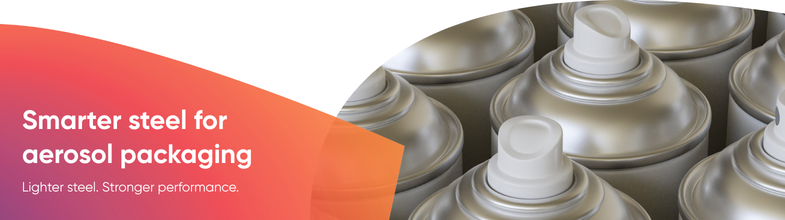
ArcelorMittal's steels for aerosol packaging
Aerosol packaging must deliver reliability, efficiency and full compliance with today’s sustainability expectations. Lightweighting, regulatory alignment and circularity are now essential for brand owners and manufacturers.
As a European leader in steel for packaging, ArcelorMittal supplies all major aerosol can producers with advanced lightweight steel solutions. Our materials enable you to meet strict performance requirements, without compromising on safety, production efficiency or design.
Why choose steel for aerosols?
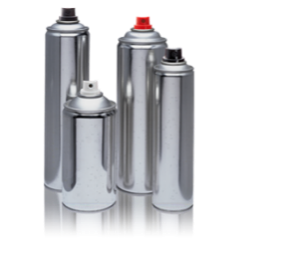
Steel’s technical properties (puncture resistance, strength to support high pressure to up to 18 bars and shiny appearance) make it an ideal choice for personal care, household, food, medical and industrial aerosols packaging.
Aerosol cans typically consist of four components: the mounting cup, top, body, and bottom. Each part requires specific performance characteristics or manufacturing conditions. We offer tailored steel solutions for each:
- Welded bodies: tight flatness control and tight thickness control to ensure excellent printability and reliable welding (H Grain mode), with high strength grades up to 580 MPa.
- Mounting cups: high-formability grades with controlled anisotropy, available in in both plain and lacquered tinplate slit coils.
- Bottoms and tops: yield strengths from 280 MPa to 650 MPa, with specific care given to anisotropy.
For monobloc bodies, we developed CS180A, a dedicated steel grade engineered to ensure optimal performance during demanding DWI manufacturing, thanks to its low anisotropy and highly consistent mechanical behavior keeping an easy formability for the necking process after wall-ironing.
Discover our standard offer and our high-performance steel grades for aerosols here.
Lightweighting to reduce material usage and CO₂ footprint
At ArcelorMittal Europe – Flat Products, we invest continuously in joint lightweighting programmes with our customers. These projects cover everything from early-stage design simulations to industrial manufacturing.
Thanks to enhanced strength properties, our latest steel grades enable:
- metal savings: ~ 17% weight reduction demonstrated on a 52 mm diameter / 210 ml aerosol can. The weight of a typical aerosol (40.6 - 43.2 g) was reduced to ~33.7 g when applied to all relevant components. Results may vary depending on application and design.
- high mechanical strength up to 650 MPa.
- controlled formability for deep drawing and shaping.
- consistent surface quality for coatings and decoration.
Innovation at the core of aerosols development
Aerosol cans must safely withstand internal pressures of 12–18 bar. They are produced as three-piece cans (body, bottom, head) or two-piece cans (drawn body and head). This requires consistent strength, formability and controlled tolerance.
Our innovation approach relies on close collaboration between our R&D teams and our customers.
Together, we accelerate developments in:
- lightweighting.
- BPA-NI (Bisphenol A Non-Intentional) coating solutions.
- CFPA (Chromium Free Passivation Alternative) technologies.
We support customers with:
- smart product selection and optimisation.
- customised support from concept to ramp up.
- design optimisation through FEA simulations and prototyping.
“Our resources complement each other. Together we make the best of our expertise, tools and experience in a collaborative environment.” – Massilly
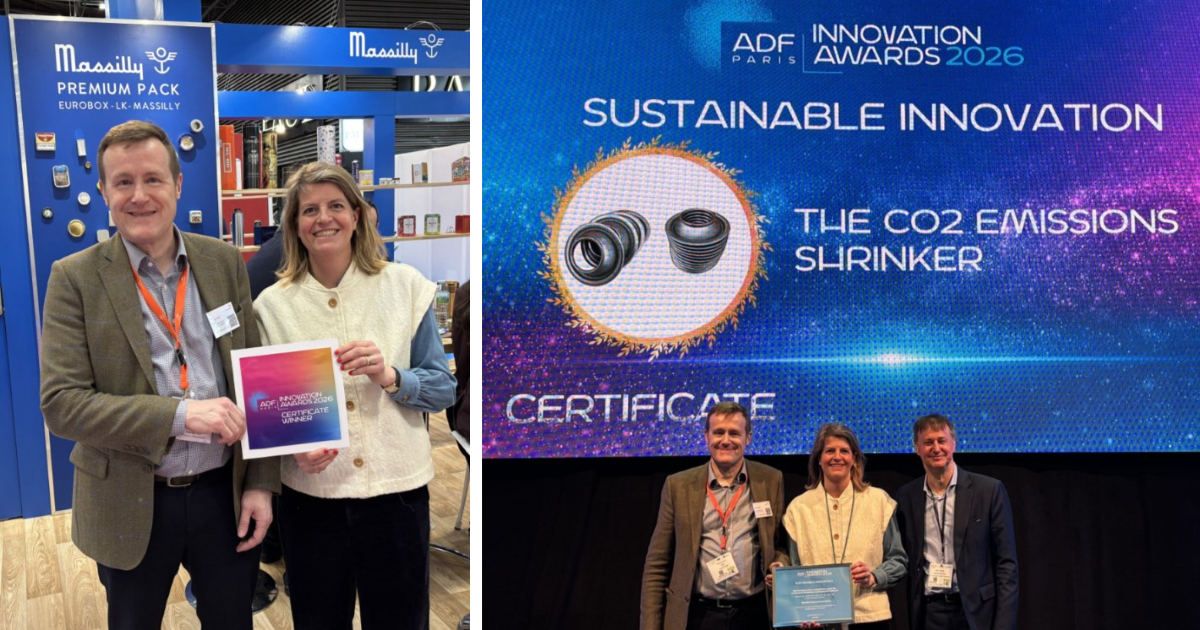
We were honoured to receive an ADF award certificate recognising our joint innovation with Massilly.
Both companies unveiled a new lightweight steel aerosol top, a breakthrough that pushes the boundaries of what’s possible in steel for packaging.
Proven expertise and award-winning solutions
Our long-standing collaboration with Massilly resulted in a award‑winning aerosol innovation (awarded the 2026 ADF Innovation Award Certificate) that reduces steel use and lowers embedded CO₂. Find out more here.
BPA-NI and PFAS free mounting cups
We offer BPA-NI, PFAS free pre-lacquered steel for aerosol mounting cups. This is the result of in-depth extensive trials and testing with partners across the entire supply chain from material supplier to brand owner.
Our industrialised solutions ensure:
- full compliance with EU food contact and chemical regulations.
- excellent formability and adhesion.
- strong resistance to a wide range of aerosol formulations.
- availability on standard and CFPA (Chromium-Free Passivation Alternative) tinplate.
“BPA-NI and CFPA are key features of our mounting cups. We work collaboratively with ArcelorMittal
to support these strategic developments.” – Lindal Group
Contact us

Do you want to know more about Aerosols? Do not hesitate to contact us.
FAQ - Steel for aerosol packaging
Why is steel a preferred material for aerosol cans?
Steel offers high pressure resistance, durability and consistent forming performance. It enables lightweighting without compromising safety and is fully recyclable.
What types of steel are used for aerosol packaging?
Most aerosols use tinplate or chromium-free coated steel, which offer excellent formability, corrosion protection and strong surfaces for printing and decoration.
Can steel adapt to different designs or branding needs?
Absolutely. Steel provides a stable surface for printing and coatings, offering high design flexibility.
What are the benefits of BPA-NI pre-lacquered steel?
It eliminates bisphenol A while maintaining excellent forming, adhesion and chemical resistance.
What is CFPA tinplate?
CFPA (Chromium Free Passivation Alternative) replaces traditional chromium-based passivation, providing corrosion protection prior lacquering without chromium substances. It is widely used for mounting cups and sensitive components.
What is EU REACH?
The Regulation on the registration, evaluation, authorisation and restriction of chemicals (REACH) is the main EU law that regulates the safe use of chemical substances across the supply chain.
What is PPWR?
The Packaging and Packaging Waste Regulation (PPWR) is an EU regulation that sets new rules for all packaging sold on the European market. It introduces, among others, recyclability performance grades, minimum recycled content targets for certain materials, and harmonised labelling obligations.
Steel for packaging is well-positioned under the PPWR. Steel already achieves high recycling rates across Europe. We will continue to align our products and documentation with the PPWR as its detailed implementing rules are adopted.
What are PFAS and why phase them out?
Per- and polyfluoroalkyl substances (PFAS) are chemicals used in a variety of industries from aerospace, automotive to construction. Due to their molecular structure, they do not degrade easily, so PFAS free alternatives are becoming standard.
How can I request more information or samples?