
“How far can lightweighting go?” This was the question raised by Laura Rigoni Medeiros, Packaging products development manager, and Gilles Mangin, Senior R&D specialist at ArcelorMittal Global R&D, as they explored the future of steel for packaging at the METPACK 2026 conference. The answer, however, went well beyond steel strength alone, focusing instead on how to balance performance, cost, sustainability and evolving consumer expectations.
Their presentation highlighted a clear shift. Steel for packaging is no longer defined solely by mechanical resistance. Instead, it is increasingly shaped by how precisely metallurgy can meet complex and often competing requirements. As this article will show, innovation in packaging steel is discovering breakthrough materials by mastering fundamental metallurgical principles with the proper combination and control.
For decades, lightweighting has been a central theme in metal packaging. Yet, the industry is far from reaching its limits. “Lightweighting is not yet done,” explains Gilles Mangin. “We are still identifying opportunities, even in mature applications.”
According to ArcelorMittal, thickness reduction of up to 15% may still be achievable within the next five years for certain applications. This is not simply an engineering ambition. This is driven by clear market forces:
Reducing steel thickness directly lowers CO₂ emissions, as less material requires less energy throughout the value chain, from steel production to forming and transport.
However, the challenge is far from linear. As thickness decreases, performance constraints increase, as Laura Rigoni Medeiros highlights, “Every micrometre removed brings new constraints. The challenge is to tackle new opportunities in the smoother industrial and economical way.”
A common rule of thumb underlines this point:
For canmakers, this translates into a delicate balancing act. Materials must be thinner, but also stronger, capable of withstanding forming, seaming, transport and internal pressure, without disrupting productivity or reliability on high-speed production lines.
While increasing strength is essential, it cannot be viewed in isolation. The real challenge lies in developing materials that are not only stronger, but also consistent, formable and fully compatible with industrial processes and regulatory requirements.
At the core of this approach is microstructure engineering. Rather than relying on a single strengthening lever, ArcelorMittal’s strategy combines multiple mechanisms to precisely control how the material behaves at the microscopic level and, ultimately, on the production line.
This is particularly relevant for packaging applications, where tight tolerances and repeatability are critical. Even small variations in material properties can quickly lead to process instability, increased scrap rates, or performance issues during canmaking. This makes consistency a key enabler of reliable, high-quality production.
Steel strengthening is based on five fundamental mechanisms: solid solution, precipitation, work hardening, grain refinement and phase transformation.
While these concepts are well-established in metallurgy, their industrial implementation for packaging requires a high level of control. Each mechanism influences not only strength, but also other critical parameters such as elongation, surface quality and response to forming.
On top of this, steel for packaging must meet strict food contact regulations, which limit both the type and concentration of alloying elements that can be used.
“We are working within a constrained design space,” says Gilles Mangin. “Every adjustment must be carefully calibrated.” In this context, the challenge is not simply to apply these mechanisms, but to fine-tune them with precision, ensuring they deliver the right balance of properties for specific applications.
In the next article, Laura and Gilles examine how this approach has been applied to easy-open ends and how innovations such as Maleïs® OpenUp are helping address evolving consumer and industry requirements.
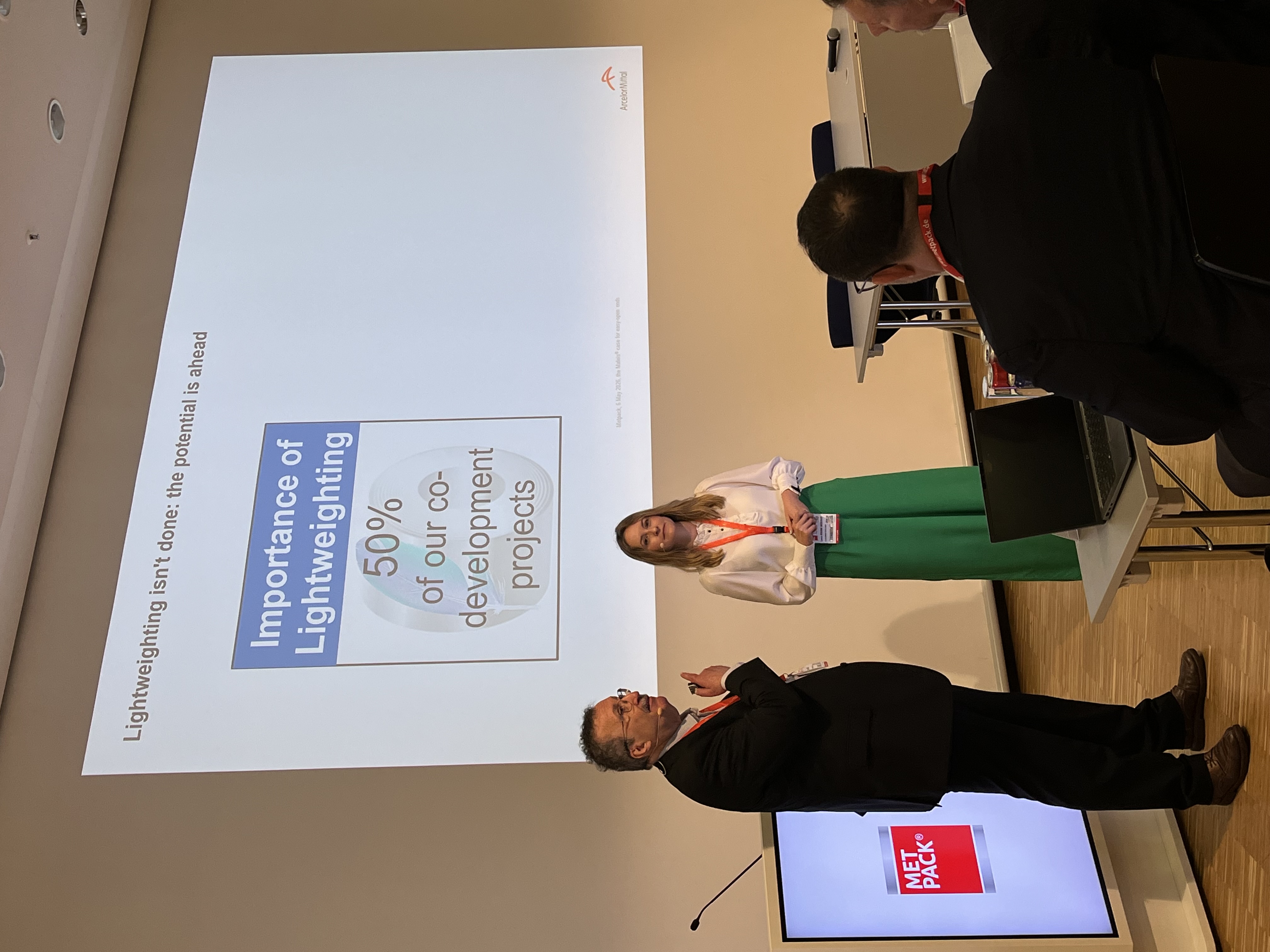
Gilles Mangin & Laura Rigoni Medeiros at METPACK 2026
© ArcelorMittal

Laura Rigoni Medeiros has been Product Development Manager for ArcelorMittal’s global packaging portfolio since April 2024, leading initiatives focused on steel solutions. She holds a degree in Materials Engineering from the Universidade Federal de Santa Catarina (Brazil), complemented by an academic exchange at INSA Rennes (France).
Laura brings a strong blend of technical and commercial expertise, with early career experience as a research engineer, followed by roles in tinplate product industrialisation and marketing. Her background enables her to bridge innovation and market needs in the packaging segment.

Gilles Mangin is a Senior R&D Specialist at ArcelorMittal Global R&D, where he oversees metal forming and new tinplate applications. He has built extensive expertise within the French steel industry over several decades.
Since beginning his career in 1988, Gilles has specialised in the tinplate sector, holding a range of technical roles spanning R&D and customer services. His long-standing experience provides deep insight into material performance, application development, and customer-driven innovation.